
Narcissistic Abuse
The Fictional Me He Abused: When Love Turns to Projection
By Maria Sarina
By Maria Sarina — Social Psychologist, Counsellor, Survivor
"Eternal Sunshine" and the Fantasy of Erasure
One of my favourite films has always been Eternal Sunshine of the Spotless Mind — a strange, aching story about heartbreak and memory. In it, two lovers choose to undergo a procedure that erases every memory of one another. They go back into their subconscious to remove the pain, delete the trace, clean the soul. And yet, as the memories vanish — one by one — something entirely unexpected happens: they fall in love again. Even in forgetting, they remember what was real. Even in erasure, love persists.
That film always haunted me. Because my reality was its mirror image — only darker.
While the characters in the film struggled to let go of memories, I found myself fighting just to hold on to the truth of who I was — because I wasn't being forgotten. I was being replaced.
Shakespeare and the Tragedy of Misrecognition
Shakespeare once wrote: "Love is not love which alters when it alteration finds." But in my story, love did alter. Not because I changed — but because the man I loved rewrote me.
Somewhere early in the relationship — long before I could name it — he began to mentally recast me. I don't know exactly when it happened, but at some point, I ceased to exist in his eyes. Not the real me — the layered, warm, whole person I was — but a shadow version. A distorted copy. A scapegoat he had constructed so he could justify his withdrawal, his cruelty, and his betrayal.
He needed me to become someone else — so he invented her.
I Dream of Serena
He once told me about I Dream of Jeannie — how the sweet, agreeable Jeannie had a dark-haired twin sister named Serena. Serena was wild. Manipulative. Seductive. Untrustworthy. She was the villain — the opposite of everything Jeannie was.
That reference stayed with me. It wasn't casual.
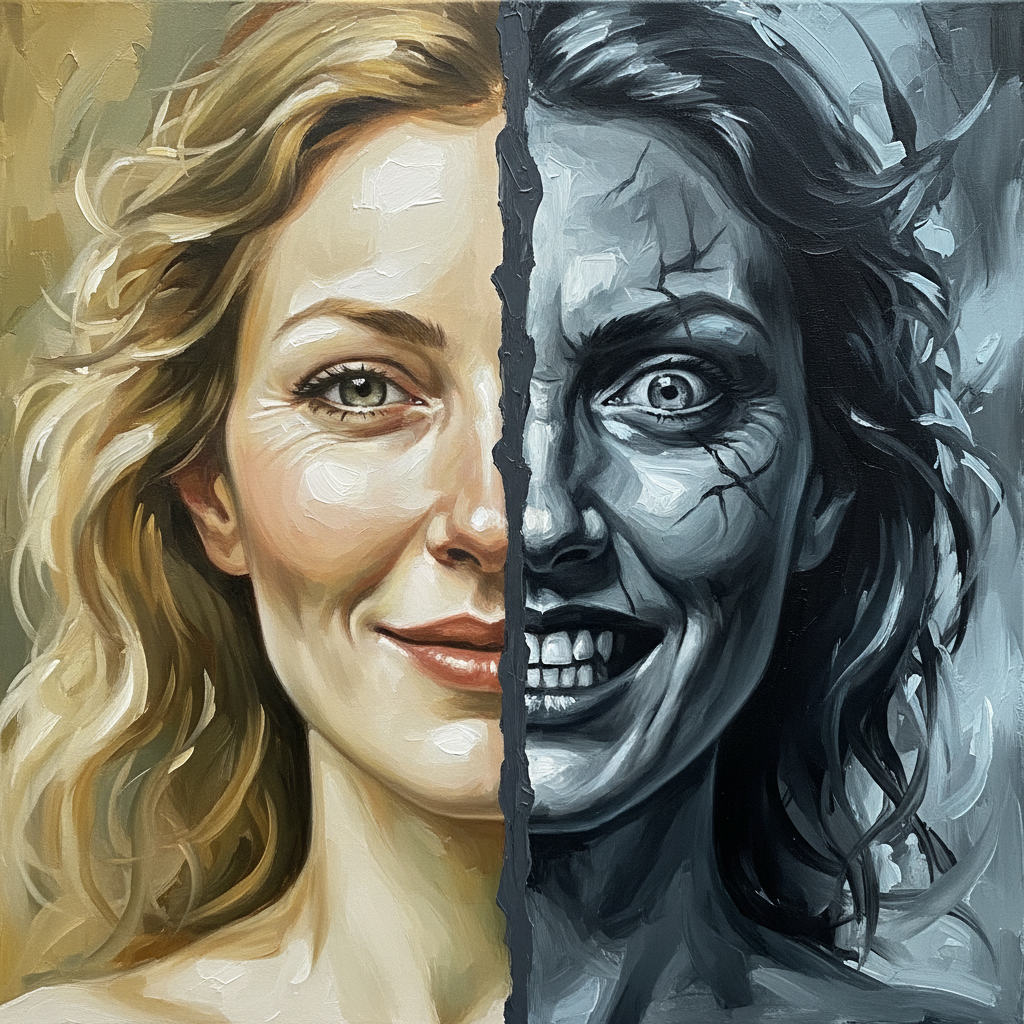
In hindsight, I believe that's exactly what he did with me. He split me in two — and projected all his discomfort, his shame, and his hatred onto the imaginary "Serena" he built in his mind.
So when he criticised me, he wasn't talking to me. When he hung up the phone, dismissed me mid-sentence, or withheld kindness, he wasn't reacting to the woman who stood in front of him. He was reacting to a fictional construct he designed and now despised.
And that's why I could never reach him.
Explaining Myself to a Wall
There were moments I tried to defend myself — not against accusations of cruelty or betrayal (I had done nothing of the sort), but against the sheer inaccuracy of the image he had created. I would replay events to him, offering every detail I could to remind him of how things actually happened. I would say, "That's not what I meant. That's not what I said. That's not who I am."
But I was arguing with someone who wasn't speaking to me. I was debating with a delusion. I wasn't present in the conversation. She was.
It was one of the most disorienting psychological experiences I've ever known: to be erased while standing in the room. To be treated like a monster, when you've only ever tried to love. To realise that your abuser has built a mental effigy of you, then punished it for crimes you never committed.
That's how he justified the abuse. That's how he walked away. He didn't abandon me. He abandoned the fictional version he had designed — the distorted character he had manufactured and projected onto me.
And in doing so, he could preserve his narrative: that I was dangerous, unstable, too much, too critical, too emotional, too hard to love. He didn't need to grieve the loss of our relationship. He needed only to discard the image he'd created — and move on.
The Psychology of Projection
From a clinical lens, what I experienced was a form of pathological projection — a process where someone disowns the parts of themselves they cannot tolerate and places them onto another. In relationships, it becomes a weapon: the partner is no longer seen clearly, but filtered through the unresolved shame and fear of the one projecting.
This projection allowed him to avoid personal responsibility, justify withdrawal and emotional neglect, externalise his own faults and failures, and maintain control without appearing abusive.
It wasn't just gaslighting. It was character assassination through mental reconstruction.
A Different Kind of Erasure
In Eternal Sunshine, memory is erased by force. In abuse, identity is erased by distortion.
What happened to me wasn't the loss of love. It was the loss of recognition. The man I loved could no longer see me. He didn't have to forget me. He simply replaced me with someone he could hate. And that was more brutal than forgetting.
Why I'm Writing This
I'm writing this for the women who've had to explain their humanity over and over to someone who already decided they weren't real.
I'm writing this for the counsellors and clinicians who need to know what this form of psychological abuse looks like from the inside.
I'm writing this because I've lived both the personal cost and the professional clarity — and now I need to speak.
If you're reading this and it sounds like your story, know this: You are not what they said you were. You are not that distorted version. You are not the villain in their mental screenplay. You are real. And your memory of yourself is accurate. Hold on to it. Guard it. Trust it.
Because in a world where abusers rewrite their partners into enemies, your memory is not just sacred — it is your proof of survival.